
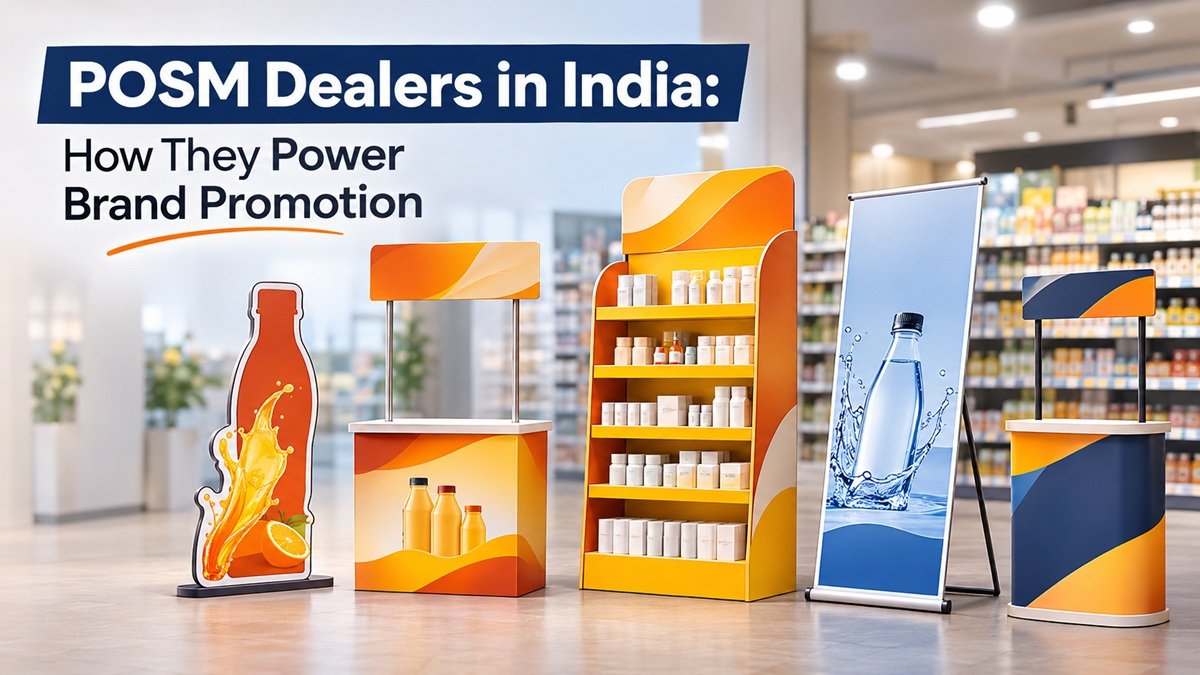
Beyond the Shelf: How POSM Dealers in India Support Brand Promotion
A brand can get the packaging, pricing and ad campaign right and still lose the sale in the last metre of the aisle. That last metre is where point-of-sale materials (POSM) work. Counter units, floor stands, shelf strips, standees, promo tables and branded headers all give a shopper one more reason to pick your product over the one beside it.
But the display is only half the story. The other half is the partner who turns your brief into hundreds of finished units that survive the journey, fit the counters they were made for, and go up in stores on time. That is the real job of POSM dealers in India, and it goes well beyond printing a logo on a stand.
This article explains what a good POSM partner does at each stage of a campaign, where things usually go wrong, and how to brief one so your displays earn their place in store. If you want a primer on stand types first, read our earlier guide on how smart POSM stands boost retail brand visibility.
What a POSM dealer actually does
In India, “POSM dealer” covers a wide range of businesses. Some are traders who resell ready-made stands. Some are printers who outsource the structure, or fabricators who outsource the graphics. Others handle design, printing and fabrication together.
That difference matters more than it seems. A POSM display in India has to work in very different places: a crowded kirana counter in a small town, a planogram-controlled supermarket aisle, a mall kiosk and a trade-fair booth. A partner who controls both the graphics and the build can adjust one to suit the other. When printing and fabrication sit with two vendors, small mismatches in size, colour or fit tend to show up only after delivery.
Six ways POSM dealers support brand promotion
1. Making the idea fit real stores
A concept that looks great on screen can fail in a 4-foot-wide medical shop. A good dealer asks where the unit will stand, how much counter or floor space retailers actually give, and whether modern-trade chains have size or placement rules. That is how a product display stand in India stays on the counter instead of ending up in the stockroom.
2. Keeping brand colours consistent
Your red should look the same on a vinyl header, a printed board and a fabric backdrop, and across the first batch and the reprint. Ask for colour proofs on the actual material before a full run, especially when a campaign uses several substrates. It also helps to ask how the dealer stores your colour settings and artwork files, so a reprint six months later doesn’t drift from the original.
3. Designing for transport and assembly
Many displays are damaged on the way to the store or assembled wrongly once they arrive. In a Retail4Growth industry feature, one POP maker estimated wastage in general trade at around 25%. That is one supplier’s estimate from 2017, not a measured national figure, but the problem it points to still applies. Flat-pack or foldable structures, clear assembly steps and sensible packing protect your spend.
4. Producing at campaign scale and speed
Festive seasons, new launches and trade schemes all come with fixed dates. A dealer with in-house production can usually plan prototypes, sample approval and phased dispatch more tightly than one coordinating several outside vendors. Build that timeline with them early, not two weeks before Diwali.
5. Supporting installation and in-store visibility
Getting a stand into the shop is not the same as getting it into the right spot. Depending on the scope you agree, a partner can help with installation, placement photos, and coordination with distributors or your field team. Eye-level placement near the billing counter or category entry is usually worth negotiating for, and a dealer who has seen many stores can tell you which positions retailers in your category tend to accept.
6. Refreshing displays without rebuilding them
A good POSM stand outlives a single campaign. Designs with replaceable graphic panels, header cards or shelf strips let you change the offer each season while reusing the structure, which helps both your budget and waste.
POSM display in Indore: why a regional partner helps
For brands selling into Madhya Pradesh, Indore is a natural base. It is the state’s biggest commercial centre and a hub for distributors serving the wider region. Working with a local partner for POSM display in Indore means you can check a prototype in person, see a material sample before signing off, and get urgent reprints without long shipping times.
When you compare product display stand dealers in Indore, ask to see finished work (not just renders), and ask which steps happen in-house. G9 Graphics, for example, has worked in printing, signage and branding for over 20 years and handles design, printing, fabrication and finishing under one roof. You can browse the range on our product display stand dealers in Indore page. Many campaigns also pair stands with in-shop branding, standees or a promotional table for sampling.
How to brief a POSM dealer: a practical checklist
Most delays and reprints come from briefs that leave out key details. Before you ask for a quote, share:
| Share this | Why it matters |
|---|---|
| Store formats and sample photos | Decides footprint, height and stand type |
| Quantity per format and city | Affects material choice, cost per unit and dispatch plan |
| Campaign dates and launch deadline | Sets the timeline for prototype, approval and production |
| Brand guidelines and final artwork | Avoids colour and layout rework |
| Product weight and dimensions | Shelves and hooks must carry real stock safely |
| Expected lifespan (one campaign or long-term) | Decides between temporary and permanent builds |
| Delivery and installation scope | Clarifies who packs, ships, installs and photographs |
Frequently asked questions
What is the difference between POSM and POP? The terms are often used interchangeably. POSM (point-of-sale materials) usually refers to the physical items, such as stands, danglers and shelf strips. POP (point of purchase) describes the place and moment where the buying decision happens.
How long does a custom display stand take to make? It depends on design complexity, materials, quantity and approval cycles. Share your launch date in the first brief so the dealer can confirm a realistic schedule.
Can one stand design work in both kirana stores and supermarkets? Sometimes, but it is rarely ideal. Many brands make a compact counter version for general trade and a larger floor unit for modern trade, using the same artwork.
Conclusion
The best POSM dealers in India do more than supply hardware. They make sure your brand looks consistent, arrives in one piece, fits the store and stays fresh beyond its first campaign. Brief them well, involve them early, and your displays will do real promotional work at the shelf.
If you are planning a retail or exhibition campaign, talk to G9 Graphics about a custom product display stand in Indore, built and printed in-house to your brand brief.